You've Been Eating Genetically Modified Foods (GMOs) for Decades — You Just Didn't Know It
What X-rays, organic pasta, and molecular scissors tell us about the food on your plate.
The paradox hiding in your organic grocery bag
Imagine standing in a supermarket, a bag of certified organic durum wheat pasta in hand. The packaging features rolling golden fields, a reassuring green leaf logo, and an implicit promise: this food is natural. No genetic tinkering. No laboratory interference.
Here is the awkward truth: there is a reasonable chance that the wheat in that bag was grown from a variety whose ancestors were deliberately bombarded with X-rays or soaked in mutagenic chemicals — processes that damage their DNA at thousands of random locations — and that this happened long before genetic engineering was even conceived.
This is not a gotcha. It is a window into one of the most misunderstood areas of modern food science: what “genetic modification” actually means, where it comes from, and why the loudest debates about it so often miss the point entirely.
Humans have always modified crop genomes — we just called it farming
Genetic modification of food crops did not begin in a laboratory. It began in the fields of the Fertile Crescent roughly 10,000 years ago, when early farmers started selecting seeds.
A wild grass produces small, brittle seeds that shatter and scatter when ripe — an evolutionary advantage for the plant, a catastrophe for anyone trying to harvest it. But occasionally, a spontaneous mutation produces a plant whose seed heads stay intact. A farmer who saves those seeds is already doing genetic selection. Over thousands of generations, the cultivated crop diverges radically from its wild ancestor.
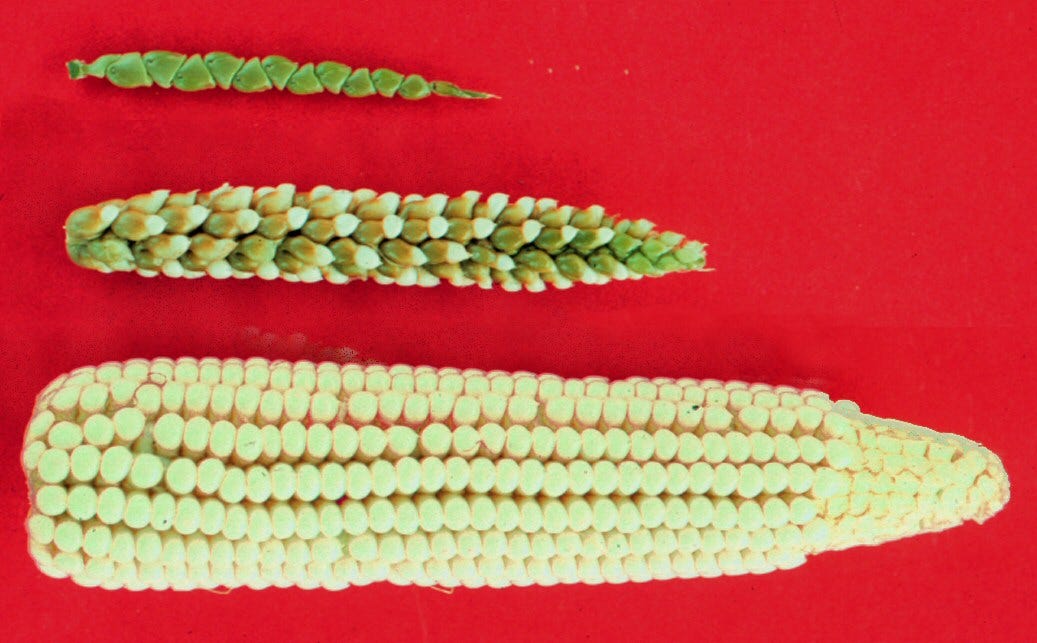
The modern corn we eat bears almost no resemblance to teosinte, its wild Mexican ancestor (see opening image). Modern wheat carries three distinct ancestral genomes, the result of ancient hybridizations between different grass species. The banana we commonly eat (Cavendish) is triploid, meaning it has three copies of each chromosome, which makes it seedless and sterile. It cannot reproduce sexually and is instead propagated through cloning (vegetative propagation), typically by replanting side shoots. As a result, Cavendish bananas are nearly genetically identical — a lack of genetic diversity that once led to the collapse of the Gros Michel variety in the 1950s and now leaves the Cavendish vulnerable to a similar fungal threat today. The orange carrot was selected by Dutch farmers from yellow and purple mutants in the 17th century. Every cultivated food crop is the product of millennia of intensive human genetic shaping — without any knowledge of DNA whatsoever.
Genetic modification, in other words, is not a departure from how we have always shaped our food. It is the latest chapter in a story that began ten thousand years ago.
What is a mutation — and why does it matter?
Before we go further, it helps to be precise about what a mutation actually is.
A mutation is simply a change in the DNA sequence of an organism. DNA — deoxyribonucleic acid — is the molecule that carries the genetic instructions for building and running every living thing, organized into a complete blueprint we call the genome. It is written in a four-letter chemical alphabet — the bases A, T, C and G — strung together in sequences three billion letters long in humans — and substantially more in many crop plants. Every time a cell divides, it must copy all three billion of these base pairs — and despite remarkably accurate proofreading machinery, errors slip through. Ultraviolet radiation from sunlight damages DNA bases directly. Naturally occurring chemicals in food and the environment modify DNA every day. Even oxygen metabolism inside cells generates reactive molecules that can alter DNA structure.
This is not a malfunction. It is a fundamental feature of biology. Mutations are the raw material of evolution — without them, there would be no genetic variation, and without genetic variation, natural selection has nothing to work with. Every trait that distinguishes one individual from another, every adaptation that allowed a species to survive a changing environment, traces back ultimately to a mutation that arose and was retained because it was useful, or at least not harmful enough to be eliminated.
Most mutations are neutral — they occur in regions of the genome with little functional consequence. Some are harmful and eliminated by natural selection. A small fraction are beneficial and spread through populations over generations. This is the quiet, ceaseless genetic churn that underlies all of life.
Understanding this is essential for what follows. When plant breeders began deliberately inducing mutations in crop seeds, they were not inventing something alien to biology. They were accelerating a process that nature runs continuously — just far more noisily, and at much higher rates.
The blunt instrument: radiation, chemicals, and thousands of mutant crops
In 1927, the geneticist Hermann Muller demonstrated that X-rays could induce mutations in Drosophila fruit flies at dramatically elevated rates — a discovery that earned him the Nobel Prize in 1946. Agricultural scientists grasped the implication immediately: if you could blast seeds with radiation or soak them in mutagenic chemicals, you could dramatically accelerate the appearance of useful mutations in crop plants.
And so they did. From the 1950s onwards, breeders began exposing seeds to gamma rays from cobalt-60 sources and to chemicals like ethyl methanesulfonate (EMS), which causes mutations throughout the genome. The logic was straightforward: create a huge population of mutant plants, grow them out, and select individuals that had acquired something useful — shorter stalks, better yield, disease resistance, altered oil composition.
Here is the part that rarely surfaces in public debate about “genetic modification”: this process is almost entirely uncontrolled.
When you irradiate a seed, you are not choosing what to change. Ionizing radiation deposits energy randomly throughout the genome, breaking DNA strands and creating deletions, inversions, and rearrangements at thousands of sites simultaneously. A single EMS-treated plant can carry thousands of new mutations scattered across its entire genome. When breeders select a plant with a desirable trait, that plant carries the entire cargo of unscreened mutations along for the ride.
Think of the genome as a book billions of characters long — every instruction needed to build and run a living plant. Now imagine taking thousands of copies of that book and bathing each one in acid, or blasting them all with radiation. Every copy sustains its own unique pattern of random damage — different pages, different sentences, different words destroyed in each one. You then plant all of them and walk through the results, searching for the single copy where a particular word on page 437 happened to change in a useful way. When you finally find it, that is the book you take forward — but it still carries all the other random damage scattered across thousands of other pages, damage you have never fully read and may never fully understand.
This approach has been used to develop more than 3,400 officially released mutant crop varieties across 233 cultivated species in 75 countries, catalogued in the FAO/IAEA Mutant Variety and Genetic Stock database. The list includes semi-dwarf rice varieties that transformed Japanese and American rice production, Diamant barley that underpins much of European brewing, the durum wheat varieties used in most Italian pasta, and a wide range of fruits and vegetables — including tomatoes, grapefruits, and pears. Rice alone accounts for more than 800 registered mutant varieties. These are mainstream commercial crops, grown and eaten by billions of people worldwide.
And here is the regulatory irony: under EU law, mutation-bred crops are explicitly exempt from GMO legislation, on the grounds that the practice has a “long history of safe use.” They are also not excluded from organic certification. A certified organic farmer can legally grow crops whose genomes were shaped by industrial-scale random mutagenesis, and that product can carry a green organic label.
This is not a scandal — the historical logic of the exemption is coherent. But it does reveal that the popular image of “natural” food is considerably more complicated than packaging suggests.
CRISPR: finally, precision
Now return to that same book — billions of characters long — but this time, you have an accurate map. You know exactly where the word you want to change is located. You send in a molecular tool that travels directly to that page, that line, that precise position, and makes exactly the change you intend. The rest of the book is untouched.
This is the essential difference between mutation breeding and CRISPR-based genome editing. In short, CRISPR uses a programmable molecular scissors — guided by a short RNA molecule — to cut DNA at a precise, predetermined location in the genome. (If you want to understand exactly how it works, I have written a dedicated post on CRISPR here.)
A critical point: a CRISPR edit can produce a result completely indistinguishable from a naturally occurring mutation. Where mutation breeding scatters random damage across thousands of locations hoping to hit the target, CRISPR goes directly to the address.
Does CRISPR lead to mutations outside the target site — so-called off-target mutations? Yes, occasionally. But here is what makes it fundamentally different from conventional mutagenesis: we can actually look. Using whole-genome sequencing, researchers can read the entire book after editing — every single page — and get, with high resolution, a comprehensive picture of changes that have occurred anywhere in the genome. If an off-target mutation is found, the plant can simply be crossed back to the original variety, and standard breeding used to separate the desired edit from the off-target change over a few generations. The unintended edit is bred away, while the intended change is retained.
This stands in stark contrast to mutation breeding, where the full extent of genomic damage has rarely been comprehensively characterized. In principle, whole-genome sequencing could also be applied to plants generated by mutagenesis. However, such plants typically carry thousands of random mutations, making it difficult to identify which changes are responsible for the desired trait and impractical to separate all unwanted variants. A 2022 review in ACS Agricultural Science & Technology confirmed that CRISPR-induced off-target mutations in plants are generally far lower in frequency than the mutation density of chemical or radiation mutagenesis — and in well-designed experiments, comparable to the spontaneous background mutation rate. With CRISPR, we know what we changed, we can sequence the entire genome to verify what else may have changed, and we have the tools to breed away anything unwanted. That combination — precision, genomic transparency, and correctability — has no equivalent in any previous approach to crop improvement.
Two kinds of GMO — a distinction that matters
When people hear “GMO,” they typically picture one specific thing: an organism that has had DNA from a completely different species inserted into its genome. A bacterial gene in maize. A viral protein in papaya. This is called transgenic modification, and it is what most regulatory frameworks were originally designed to evaluate.
The canonical examples are well known. Bt crops — maize and cotton engineered to produce an insecticidal protein from the soil bacterium Bacillus thuringiensis — have been grown commercially since the mid-1990s. The protein is toxic to specific insects but not to mammals, birds, or fish; it has been used as a spray in organic farming for decades. Golden Rice carries genes from maize and a bacterium to produce beta-carotene in the grain. And insulin for diabetic patients has been produced in transgenic bacteria and yeast since the early 1980s — a fact that gives pause to anyone who considers transgenic technology categorically unacceptable.
The scientific consensus on the safety of approved transgenic foods for human consumption is clear and consistent. The WHO, the European Food Safety Authority, and the US National Academies of Sciences, Engineering, and Medicine have all concluded that the transgenic crops currently on the market pose no greater risk to human health than their conventional counterparts. After decades of consumption across billions of people, there is no credible evidence of harm attributable to the genetic modification itself. This does not mean that every future transgenic product is safe by definition — case-by-case evaluation remains essential — but it does mean that the category of “foreign gene in a food crop” is not inherently dangerous.
It is also worth remembering that nature has been inserting foreign DNA into genomes for hundreds of millions of years. Nearly half of the human genome consists of sequences originally derived from viruses and other mobile elements that integrated themselves into our ancestors’ DNA over evolutionary time — a story explored in depth in a previous post, which you can read here. The concept of “foreign DNA” is not nearly as unnatural as it sounds.
CRISPR-based editing is, in many applications, a fundamentally different proposition. When CRISPR is used to edit a plant’s own genome — disrupting a gene, correcting a variant, or making a small targeted change — no foreign DNA need be introduced at all. The result can be a plant carrying a change identical to variants already found in nature, where such mutations have arisen spontaneously and their benefits are well documented. The difference is how we get there: with complete molecular precision and full traceability. Whether such a plant should be regulated as a GMO at all is one of the central debates in agricultural policy today — and one that is finally beginning to be resolved.
What can this actually do for our food?
The applications range from narrowly technical to potentially transformative.
Nutrition. Golden Rice 2 produces up to ~37 micrograms of beta-carotene per gram of grain — concentrations unachievable in the original variety and sufficient to meaningfully address vitamin A deficiency in populations where rice is the dietary staple. Vitamin A deficiency causes preventable blindness and immune dysfunction in millions of children worldwide. CRISPR has since been used to increase iron, zinc, and folate content in rice — concentrations similarly difficult to achieve through conventional breeding due to limited natural genetic variation.
Climate resilience. CRISPR has been applied to edit drought and heat stress response genes in rice, wheat, and maize, improving water use efficiency and stress tolerance. As growing seasons shift and extreme weather becomes more frequent, crops engineered to tolerate temperature and water stress could mean the difference between a harvest and a failure.
Lower environmental footprint. Paddy rice cultivation is a significant source of methane. Disease-resistant varieties can reduce fungicide use. Crops adapted to lower fertilizer inputs reduce nitrous oxide emissions — a greenhouse gas roughly 300 times more potent than CO₂ over a century.
Disease resistance. The Cavendish banana mentioned above — roughly half of all global banana production — faces existential threat from Fusarium wilt, a soil fungus eerily reminiscent of what destroyed the Gros Michel variety in the 1950s. CRISPR-based resistance approaches are under active development. Gene-edited crops resistant to fungal diseases like powdery mildew, bacterial infections, and viral pathogens have already been produced across a range of species.
The concerns worth taking seriously
The ecological and societal concerns around GMOs are not uniformly baseless — they simply need to be separated from the ones that are.
Gene flow between engineered crops and wild relatives is a real consideration, though its significance varies enormously by species and geography. Herbicide-tolerant crops have in some cases contributed to herbicide-resistant weeds — an agronomic management problem more than an intrinsic property of the genetic modification itself.
The more substantive concerns are about power and access. Commercial deployment of patented transgenic varieties has contributed to significant consolidation in the global seed industry, raising legitimate questions about farmer autonomy, seed-saving rights, and whether profit motive determines which problems biotechnology is actually applied to. These are important political and economic questions — but they apply to the legal frameworks surrounding the technology, not to the biology itself.
Europe is finally catching up
For decades, the EU presented a striking paradox: mutation-bred crops — with thousands of random, uncharacterized mutations — were exempt from GMO legislation, while CRISPR-edited crops capable of making a single, precisely defined change — one that can be identical to mutations already found in nature — were classified as GMOs under a 2018 court ruling, requiring full regulatory review.
That is now changing. In December 2025, the EU reached a provisional agreement on a new framework introducing a two-tier system. Plants with small, targeted changes equivalent to natural mutations — designated NGT-1 — are exempted from GMO legislation and sold without GMO labelling. More extensively modified plants — NGT-2 — remain subject to full regulation. Herbicide-tolerant plants and those producing insecticidal compounds are automatically NGT-2 regardless of edit size. And all gene-edited plants — including NGT-1 — remain prohibited in organic farming, even as crops produced through conventional mutation breeding, which may carry thousands of random, uncharacterized mutations induced by chemicals or radiation, continue to be permitted there. Conventional mutation breeding remains entirely exempt from GMO legislation. The paradox is only partially resolved.
The regulation is expected to enter into force around 2028 — a timeline that itself reflects how slowly policy has moved. The original GMO rules were written in 2001, for a technology that moved genes between unrelated species. CRISPR did not exist then. It took more than two decades for European regulators to acknowledge that a tool capable of making a single, targeted change to a plant’s own genome deserved its own framework — rather than being lumped in with techniques it has little in common with.
The spectrum we were never told about
The phrase “genetically modified organism” carries enormous emotional weight — and almost no descriptive precision. Everything on your plate has been genetically shaped by human activity. The relevant questions have never been whether modification has occurred, but what was changed, how well we understand it, and what purpose it serves.
At one end of the spectrum sits mutation breeding: effective, commercially mainstream, present in organic food, and producing organisms with genomic change that is vast, largely uncharacterized, and essentially impossible to audit at the molecular level.
At the other sits CRISPR: capable of changes that are precise, targeted, fully sequenceable, and often indistinguishable from variants that arise naturally — with unintended effects measurably fewer than those of conventional mutagenesis, and with the tools to find and eliminate them if they occur.
The popular debate has the risk gradient almost exactly backwards. A CRISPR-edited crop that adds vitamin A to a staple food, reduces a harvest-destroying fungal disease, or lowers agricultural emissions should be evaluated on the merits of those specific changes — not on the reflexive discomfort of the word “modification.”
Mutations are how life has always explored what is possible. We now have a tool to do that exploration with intention, precision, and the ability to read every consequence. What we choose to do with it is a different, and fully human, question.
Background and further reading
Muller, H.J. Artificial transmutation of the gene. Science, 1927.
Ahloowalia, B.S., Maluszynski, M., & Nichterlein, K. Global impact of mutation-derived varieties. Euphytica, 2004.
Jinek, M., Chylinski, K., Fonfara, I., Hauer, M., Doudna, J.A., & Charpentier, E. A programmable dual-RNA–guided DNA endonuclease in adaptive bacterial immunity. Science, 2012.
Modrzejewski, D., Hartung, F., Lehnert, H., Sprink, T., Kohl, C., Keilwagen, J., & Wilhelm, R. Which factors affect the occurrence of off-target effects caused by the use of CRISPR/Cas: a systematic review in plants. Frontiers in Plant Science, 2020.
Holme, I.B., Gregersen, P.L., & Brinch-Pedersen, H. Induced genetic variation in crop plants by random or targeted mutagenesis: convergence and differences. Frontiers in Plant Science, 2019.
Paine, J.A., Shipton, C.A., Chaggar, S., Howells, R.M., Kennedy, M.J., Vernon, G., Wright, S.Y., Hinchliffe, E., Adams, J.L., Silverstone, A.L., & Drake, R. Improving the nutritional value of Golden Rice through increased pro-vitamin A content. Nature Biotechnology, 2005.
Sturme, M.H.J., van der Berg, J.P., Bouwman, L.M.S., De Schrijver, A., de Maagd, R.A., Kleter, G.A., & Battaglia-De Wilde, E. Occurrence and nature of off-target modifications by CRISPR-Cas genome editing in plants. ACS Agricultural Science & Technology, 2022.
Dong, O.X., Yu, S., Jain, R., et al. Marker-free carotenoid-enriched rice generated through targeted gene insertion using CRISPR-Cas9. Nature Communications, 2020.
National Academies of Sciences, Engineering, and Medicine. Genetically Engineered Crops: Experiences and Prospects. The National Academies Press, Washington, 2016.
Wesseler, J., & Zilberman, D. The economic power of the Golden Rice opposition. Environment and Development Economics, 2014.